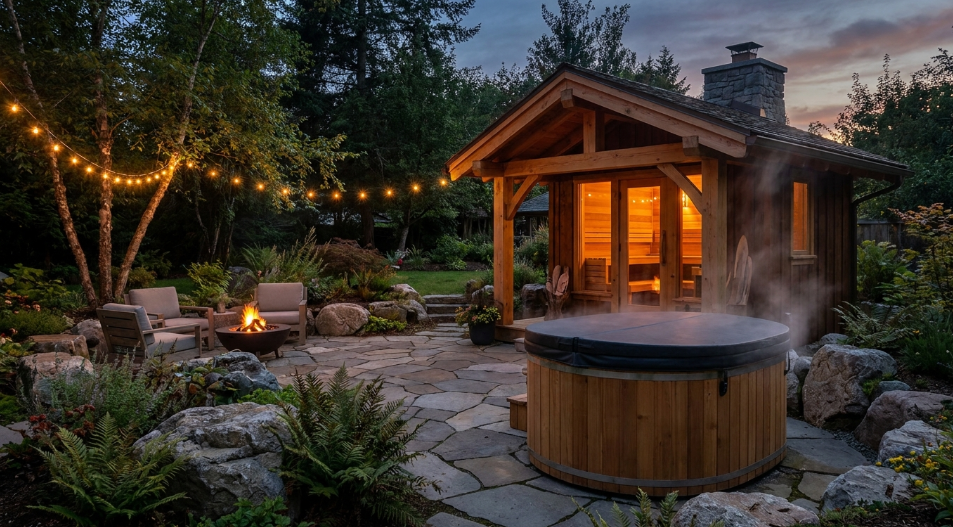
When a yard or budget cannot support a full-size barrel sauna, the realistic alternatives are a one or two-person mini barrel, an indoor infrared cabin, or a portable tent sauna, roughly in that order of cost and permanence. A mini barrel keeps the traditional heat experience in a footprint as small as 4 by 6 feet. An infrared cabin often runs on standard household power and fits indoors. A portable tent sauna costs the least and needs no installation, at the tradeoff of a less consistent, lower-intensity session.
What Are the Realistic Alternatives to a Full-Size Barrel?
Three categories cover most of the market below full barrel size: compact one or two-person barrel or cabin units, indoor infrared cabins, and portable fabric or tent-style saunas. Each trades something specific for its smaller footprint or lower cost, whether that is capacity, the type of heat, or how permanent the structure is. None of them is a straight downgrade; they suit different constraints, a small yard, no outdoor space at all, or a genuinely limited budget, better than trying to squeeze a family-size barrel into a space it was never designed for.
Is a Two-Person Mini Barrel a Real Option?
Yes, and it is the closest substitute to a full barrel in terms of the actual heat experience, since it uses the same wood construction and heater technology, just scaled down. A mini barrel can fit in a footprint as small as roughly 4 by 6 feet, which opens up smaller yards, patios, and side-lot spaces that could never accommodate a six-person unit. The site requirements do not shrink proportionally, though: it still needs a level, well-drained base and, depending on heater size, often a dedicated electrical circuit, just sized to a smaller load than a family unit would need.
What About an Indoor Infrared Cabin?
An infrared cabin heats the body directly with panels rather than warming the surrounding air the way a traditional barrel does, which means it runs at a lower ambient temperature, typically 120 to 150 degrees Fahrenheit versus 150 to 190 for a traditional heater. That lower draw means many compact infrared units can run on a standard 120V household circuit, avoiding the electrical work a barrel typically requires. The experience is genuinely different, though, less of the intense dry heat and steam sauna purists expect, and more of a direct, lower-intensity warmth. For someone without any usable outdoor space, it is often the only realistic option rather than a compromise chosen for its own sake.
Do Portable Tent Saunas Actually Work?
A decent portable tent sauna, generally a fabric enclosure with a small electric heater, can reach a genuinely warm, sweat-inducing temperature, though it runs lower and less evenly than a hardwired barrel or cabin. These units cost a few hundred dollars rather than several thousand and need no installation beyond an outlet, which makes them a reasonable way to test whether sauna use actually becomes a regular habit before committing to a permanent structure. The tradeoff is durability and consistency: fabric enclosures do not hold heat as evenly, and most are not built for years of daily use the way a wood barrel or cabin is. Setup and takedown also fall entirely on the owner each time, which is fine for occasional use but becomes a real chore if the goal is a genuinely regular routine several nights a week.
What About a Sauna Blanket or Single-Person Pod?
A sauna blanket or compact heated pod sits at the smallest end of the spectrum, essentially a body-length heated wrap that plugs into a standard outlet and needs no dedicated space beyond a corner of a bedroom or bathroom. It delivers direct radiant heat similar in principle to an infrared cabin, just scaled down to a single user with no room to move around in. This option suits someone in an apartment with no outdoor access and no interest in a shared cabin experience, though it is a fundamentally different, more solitary use case than any barrel or cabin option and will not satisfy someone who wants a household sauna others can join.
What Does Downsizing Actually Save on Electrical and Site Cost?
A mini barrel or small infrared cabin commonly avoids the 240V circuit that a family-size heater requires, which alone can save $800 to $2,000 or more depending on distance from the panel. Foundation cost scales down with footprint too, since a smaller base needs less material and less excavation. Buyers weighing the tradeoff between a smaller home unit now versus saving toward a full barrel later can compare specific heater wattage and footprint requirements across models at https://sweatdecks.com and other specialty retailers, since the electrical requirement is usually the detail that decides whether downsizing meaningfully simplifies a project or just shrinks the sauna without changing the install complexity much.
Does a Smaller Sauna Still Offer the Same Associated Benefits?
The observational research behind sauna use tracks session frequency and consistency over time, not the size of the unit someone owns. A 2018 review in Mayo Clinic Proceedings summarizing cardiovascular associations tied to regular use does not distinguish between a large traditional cabin and a compact barrel, since the underlying studies were built around how often people used a sauna, not the specific structure. A smaller unit used three times a week is more aligned with the pattern the research actually measures than a large barrel that sits mostly unused because it never fit the household’s routine.
When Does It Make More Sense to Just Use a Gym or Spa Sauna?
If space, budget, or an uncertain future move make any home installation impractical, using a sauna at a gym, spa, or community center two or three times a week can deliver a similar frequency of exposure without any upfront structure cost. The downside is convenience and consistency: access depends on hours, membership cost, and whether the facility maintains its equipment properly, none of which is guaranteed the way a home unit is. For someone who already has consistent access to sauna heat elsewhere, a home unit is more about convenience than a health-driven requirement, and that is a reasonable, honest way to frame the decision rather than assuming ownership is always the better path.
Frequently Asked Questions
What is the smallest real barrel sauna option available? One and two-person mini barrels can fit in a footprint as small as roughly 4 by 6 feet, though they still need a level base and often a dedicated circuit.
Is an indoor infrared cabin a good substitute for a barrel sauna? It can be, especially without outdoor space. It runs cooler and often fits a standard household circuit, but the experience differs from traditional heat.
Do portable tent saunas actually get hot enough to matter? Decent models reach a genuinely warm temperature, though less consistently than a hardwired unit. They suit renters or anyone testing the habit first.
Does a smaller home sauna option still offer the same associated health benefits? The research tracks frequency and consistency, not unit size, so a smaller sauna used regularly aligns better with the studied pattern than a large one used rarely.
References
- Cardiovascular and Other Health Benefits of Sauna Bathing: A Review of the Evidence, Mayo Clinic Proceedings, 2018
- Clinical Effects of Regular Dry Sauna Bathing: A Systematic Review, Evidence-Based Complementary and Alternative Medicine, 2018
- Does the Combination of Finnish Sauna Bathing and Other Lifestyle Factors Confer Additional Health Benefits? A Review of the Evidence, Mayo Clinic Proceedings, 2023
- Effects of heat and cold on health, with special reference to Finnish sauna bathing, American Journal of Physiology, 2018